
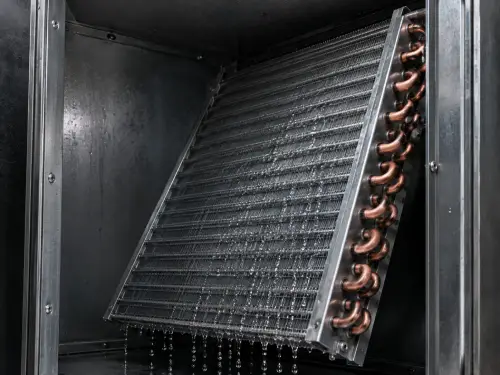
Water on an evaporator coil is normal while your air conditioner is cooling. The concern is when water falls off the coil in the wrong place, misses the drain pan, blows into the blower section, or leaks from the air handler cabinet. That can point to airflow, coil condition, freezing, refrigerant distribution, installation, or condensate-management problems—not only a clogged drain line or cracked drain pan.
Quick Answer
Your evaporator coil removes heat and humidity from indoor air. As warm, humid air passes across the cold coil, moisture condenses on the fins. That water should cling to the coil, travel downward, and fall into the drain pan below.
If water is dripping, spraying, or blowing past the pan, the cause may be excessive airflow, a dirty coil, a frozen-and-thawing coil, uneven refrigerant feeding across the coil, an improperly installed coil or pan, or a missing internal water diverter.
A clogged drain line is different because it normally causes water to back up inside the drain pan. A cracked pan is different because water leaks from the pan itself. When water appears to be falling from a particular spot on the coil before it reaches the pan, the technician needs to inspect the coil, airflow, refrigerant circuit, and condensate path together.
What Should Happen to Water on an AC Coil?
During normal cooling operation, the evaporator coil becomes colder than the humid indoor air moving through it. Water vapor condenses on the coil in the same way moisture forms on the outside of a cold glass.
In a properly operating system, condensate should follow this path:
- Moisture forms on the evaporator coil fins and tubing.
- Small droplets collect into larger droplets.
- The droplets travel downward along the coil by gravity.
- Water falls into the primary drain pan.
- The drain pan sends water through the condensate drain line and out of the home.
A small amount of water dripping from the lower edge of the coil into the drain pan is normal. Water that misses the pan, lands in the blower section, wets cabinet insulation, or leaks into the home is not.
Water Off the Coil vs. a Drain Problem
Water shedding or blowing off the coil
This means condensate is not making its way into the drain pan correctly. Water may appear to rain from the coil, drip from the middle of a slant coil, collect downstream of the coil, or get carried by airflow toward the blower section. The drain line may still be clear and draining normally.
Clogged condensate drain line
A clogged drain line usually causes water to back up in the drain pan. Algae, dust, insulation particles, insects, sludge, or debris can restrict the PVC pipe that carries condensate away. Once the pan fills faster than it can drain, water can overflow from the pan or trigger a float switch.
For a closer look at that specific issue, see Why Is There Water Around My Indoor AC Unit?.
Cracked or damaged drain pan
A cracked drain pan can leak even when the drain line is open and functioning. In that case, water may enter the pan normally but escape through a crack, failed fitting, rusted area, or damaged pan seam before it reaches the drain connection.
Improper drain trap or drain piping
Some air handlers operate under negative pressure. If the condensate trap is missing, improperly installed, too shallow, blocked, or incorrectly vented, the drain may not flow as intended. Water can remain in the pan, rise higher than normal, splash, or overflow. That is still a condensate-drain problem, but it can sometimes look like water is coming off the coil.
Why Water May Drip Off an Evaporator Coil
1. Excessive airflow is blowing water off the coil
One of the most overlooked causes is excessive air velocity across the evaporator coil. The coil needs the correct airflow pattern and enough time for water droplets to drain downward. When air moves too quickly across a wet coil, it can pull droplets off the fins and carry them downstream.
This is often called water blow-off, condensate carryover, or moisture carryover.
Possible reasons include:
- Blower speed set too high
- Incorrect ECM blower setup or airflow profile
- The wrong speed tap selected after a repair
- A duct system with unusually low resistance
- An improperly matched indoor coil, air handler, or blower
- Missing coil baffles, splash guards, or water diverters
- An oversized blower or improperly configured replacement air handler
Too much airflow is not always better. Low airflow can cause freezing, but very high airflow can cause water carryover and poor humidity removal. Learn more in Why Airflow CFM Per Ton Matters.
2. A dirty evaporator coil is disrupting drainage
A dirty coil can change the way water moves across the fins. Dust, pet hair, nicotine residue, oily film, biological growth, construction debris, and insulation fibers can keep condensate from draining evenly.
Instead of water moving smoothly down the fins, it may bridge across fin openings, form sheets, collect into larger droplets, or release in uneven areas where airflow is strongest. A dirty coil can also reduce open fin area, which increases air speed through the remaining open areas and makes water carryover more likely.
Heavy coil buildup can also restrict airflow enough to contribute to freezing. See Can a Dirty Evaporator Coil Cause My AC to Stop Cooling? for more detail.
3. The coil froze and is now thawing
A frozen evaporator coil can hold a large amount of ice. When cooling stops or the system begins to thaw, that ice can melt quickly. The drain pan is designed to handle normal condensation, but a heavily frozen coil may release water faster than the pan and drain system can manage.
That meltwater can run off the coil in sheets, drip from locations that are normally dry, overflow the pan, or enter parts of the air handler that should not get wet.
Common causes of coil freezing include:
- A dirty, restrictive, collapsed, or incorrectly sized air filter
- A dirty evaporator coil
- A dirty blower wheel
- A weak indoor blower motor
- Blocked return-air airflow
- Closed supply vents throughout the home
- Low refrigerant caused by a leak
- A refrigerant metering-device issue
- Cooling operation during unusually cool outdoor weather without the correct controls
If you see ice on the indoor coil area or the larger insulated refrigerant line, turn the cooling system off and allow it to thaw before restarting it. Read Why Is My Air Handler Freezing Up? for additional troubleshooting information.
4. Low refrigerant or a metering problem is underfeeding part of the coil
An evaporator coil does not always operate at one uniform temperature from end to end. Refrigerant enters through a metering device, then travels through the coil circuits as it absorbs heat and changes state.
When the system is undercharged, when the metering device is restricted or malfunctioning, or when refrigerant is not distributing evenly through the coil circuits, part of the coil may be underfed. That can leave some portions of the coil colder and actively boiling refrigerant while other portions become warmer and more superheated.
Those warmer areas may not stay wet in the same way as the colder sections. As condensation trails down the fins from above, the change in coil temperature and surface wetting can cause water to sheet together, pool briefly, and drop from a specific point instead of draining evenly across the coil.
This is especially worth considering when you see one or more of these patterns:
- Only part of the coil is heavily sweating or frosted
- One section of the coil is noticeably warmer than another
- Water repeatedly drops from the same middle area of the coil
- The system has low suction pressure or unusually high superheat
- Cooling is weak even though airflow appears normal
- The coil has a partial-freeze pattern instead of freezing evenly
- The problem returns after the drain line has already been cleared
Water dripping from one location does not prove a refrigerant problem by itself. Dirty fins, airflow, coil pitch, cabinet pressure, and water diverters can create similar patterns. But a partially active or poorly fed evaporator coil should be part of a thorough diagnosis.
For related refrigerant symptoms, see How Can I Tell If My AC Refrigerant Is Low?.
5. The coil is installed in the wrong position
Indoor coils and air handlers can be installed in several configurations, including upflow, downflow, horizontal-left, and horizontal-right. Some configurations require drain-pan changes, drain-connection changes, factory plugs to be moved, coil supports to be repositioned, or additional conversion parts.
If one of those steps is missed, water may not reach the intended portion of the drain pan. It may spill over an edge, drip from the wrong side of the coil, or land in an area of the cabinet not designed to handle condensate.
This is especially worth considering when the water problem begins after:
- An air-handler replacement
- An evaporator-coil replacement
- An attic installation
- A major ductwork change
- A conversion from vertical to horizontal airflow
- A blower repair or cabinet modification
6. The coil is not seated correctly over the pan
When a coil is removed for repair, cleaning, or replacement, it must sit squarely and correctly inside the cabinet. If the coil is tilted, shifted, unsupported, or not aligned with the pan, condensate may bypass the pan altogether.
This can look very similar to a cracked pan or clogged drain line from the outside. The difference is that the water is not necessarily reaching the pan in the first place.
7. An internal baffle, drip lip, or water diverter is missing
Some indoor units use metal baffles, molded plastic guides, foam dividers, splash shields, coil extensions, or drip lips to direct water toward the drain pan and prevent the blower from carrying droplets away from the coil.
If one of those pieces is missing, damaged, shifted, or removed during a past repair, water can begin leaving the coil in an unintended direction. This is usually not visible until the correct service panel is removed and the coil compartment is inspected.
8. High humidity is exposing a marginal problem
Florida systems can remove a large amount of moisture during hot and humid weather. High humidity alone should not cause a properly installed air handler to throw water outside the pan. However, heavy moisture load can reveal a coil, airflow, pan, refrigerant-distribution, or drain problem that is only barely working under normal conditions.
Humidity is often the amplifier—not the underlying cause.
9. Air leaks or cabinet pressure issues are changing the airflow path
Loose access panels, missing gaskets, damaged coil doors, open cabinet penetrations, or poorly sealed duct connections can alter pressure and airflow around the coil compartment.
Depending on the equipment design, those pressure changes can affect drain performance, interfere with the trap, and change how water leaves the coil. The result may be droplets pulled downstream instead of draining into the pan.
How to Tell Which Problem You Have
Signs the drain line may be clogged
- Standing water in the primary drain pan
- Water rising around the primary drain outlet
- Water coming from a secondary drain outlet
- A float switch shutting the system down
- No water coming from the outside drain termination during long humid cooling cycles
- Algae, sludge, or debris visible in the drain cleanout
Signs the drain pan may be cracked
- Water drips from the same location beneath the pan
- The drain line appears to be flowing normally
- The pan is not visibly full, but water still appears under the unit
- Water appears after the system runs long enough to partially fill the pan
- The leak continues after the coil is no longer visibly wet
Signs water may be shedding or blowing off the coil
- The drain pan is not overflowing, but nearby cabinet sections are wet
- Water appears downstream of the coil or near the blower compartment
- The drain line is open and flowing, but water still misses the pan
- The issue is worse at higher blower speeds
- The coil has visible dirt buildup, wet streaking, or uneven drainage patterns
- The air handler has a history of freezing up
- The problem began after coil, blower, duct, or air-handler work
Signs refrigerant underfeeding may be involved
- Only part of the coil sweats, frosts, or freezes
- Water consistently drips from the same section of the coil
- The system has weak cooling with apparently normal indoor airflow
- The coil looks unevenly active rather than evenly wet across its face
- The system has a known refrigerant leak history
- A prior technician reported high superheat, low suction pressure, or a possible metering restriction
What You Can Safely Check First
- Turn the cooling system off if water is entering the cabinet, leaking near wiring, dripping onto a ceiling, or pooling around the air handler.
- Check the air filter. Replace it if it is dirty, collapsed, visibly restricted, or incorrectly sized. See How Often Should I Change My Air Filter?.
- Look for ice. Check the larger insulated refrigerant line near the air handler and look through any safe viewing area. Do not touch exposed electrical components.
- Look for standing water in the pan. A full pan points more strongly toward a clogged drain, trap, or drainage issue.
- Check the drain termination outside. A dry drain outlet during a long humid cooling cycle can be a clue, but it does not confirm a blockage by itself.
- Notice whether only one coil section is wet or frozen. An uneven coil pattern is useful information for the technician, especially if water repeatedly drops from the same location.
- Leave cabinet panels in place while the unit runs. Removing access panels can change airflow and pressure conditions, making water behavior look different than it does during normal operation.
Do Not Blast the Coil With Compressed Air
Compressed air can bend delicate aluminum fins, drive debris deeper into the coil, scatter water into electrical areas, and damage internal insulation. A heavily impacted evaporator coil may need professional cleaning and airflow testing rather than a quick spray through the access opening.
What a Technician Should Check
When water is coming off the coil instead of draining normally, the technician should inspect the entire condensate path—not only the drain line.
- Evaporator coil condition: Dirt buildup, biological growth, damaged fins, icing, and uneven water patterns
- Blower and airflow: Filter condition, blower-wheel cleanliness, blower speed, static pressure, and likely CFM
- Condensate carryover: Evidence that water droplets are being pulled downstream by airflow
- Drain pan condition: Cracks, rust, damaged fittings, improper pitch, and overflow evidence
- Drain setup: Primary drain, secondary drain, trap depth, venting, cleanout, slope, and termination
- Coil installation: Correct orientation, proper seating, cabinet fit, and factory water-management parts
- Refrigerant feed: Suction pressure, superheat, subcooling when applicable, metering-device operation, refrigerant charge, and possible circuit distribution concerns
- Freeze-up causes: Airflow restriction, blower performance, refrigerant symptoms, and control operation
This approach helps separate a basic drain-cleaning repair from a coil-cleaning, airflow, refrigerant, installation, or component-correction issue.
When to Call for AC Service
Schedule service when water is leaving the intended drain path, especially if it is entering the blower compartment, wetting electrical components, staining a ceiling, pooling around the indoor unit, or returning after a drain line has already been cleared.
You should also call sooner if you see ice on the coil or refrigerant line, notice weak airflow, hear the blower struggling, find uneven frost or sweating across the coil, or see water repeatedly dropping from one specific area.
Beacon’s friendly technicians in yellow can inspect the coil, drain pan, blower setup, airflow, refrigerant performance, metering operation, and condensate system together so the actual cause is identified instead of guessing at parts.
AC Coil Dripping Water FAQs
Is it normal for water to drip from an evaporator coil?
Yes, as long as the water drips into the drain pan below the coil. It is not normal for water to miss the pan, blow into the blower section, soak cabinet insulation, or leak from the air handler.
Can too much blower speed cause water to blow off an AC coil?
Yes. Excessive air velocity can pull water droplets off a wet evaporator coil and carry them downstream. This is often called water blow-off or condensate carryover.
Can a dirty evaporator coil cause water to drip inside the air handler?
Yes. Dirt can interfere with normal condensate drainage, create uneven water shedding, increase airflow velocity through open coil areas, and contribute to coil freezing.
Can low refrigerant cause water to drip from one part of the coil?
It can. Low refrigerant, poor refrigerant distribution, or a metering-device problem can underfeed part of the coil. That may leave uneven coil temperatures and wetting patterns, allowing water to collect and drop from a particular area. A technician should confirm this with airflow and refrigerant diagnostics because the drip location alone does not prove the cause.
Does water dripping off the coil always mean the drain line is clogged?
No. A clogged drain line normally causes water to back up in the drain pan. Water dripping or blowing off the coil before it reaches the pan can be caused by airflow, coil condition, refrigerant underfeeding, freezing, installation, or missing internal water-management parts.
Can low refrigerant cause water to leak from my AC?
Low refrigerant can cause the evaporator coil to freeze. When the ice melts, the resulting water can overwhelm the drain pan or leak into areas that normally stay dry. Refrigerant does not get used up under normal operation, so a low-refrigerant condition should be professionally diagnosed for a leak or system issue.
Can I run my AC if the coil is dripping water?
Turn cooling off if water is leaking into the cabinet, near electrical components, around the air handler, or onto a ceiling. Continuing to run the system can increase water damage and make a frozen-coil issue worse.
How can a technician tell if the drain pan is cracked?
A technician can inspect the pan, verify the drain is flowing, look for water patterns, and perform a controlled water test. Some cracks only leak once water reaches a certain level.