
Repair or replace your washer or dryer?
When should you repair vs replace a washer or dryer?
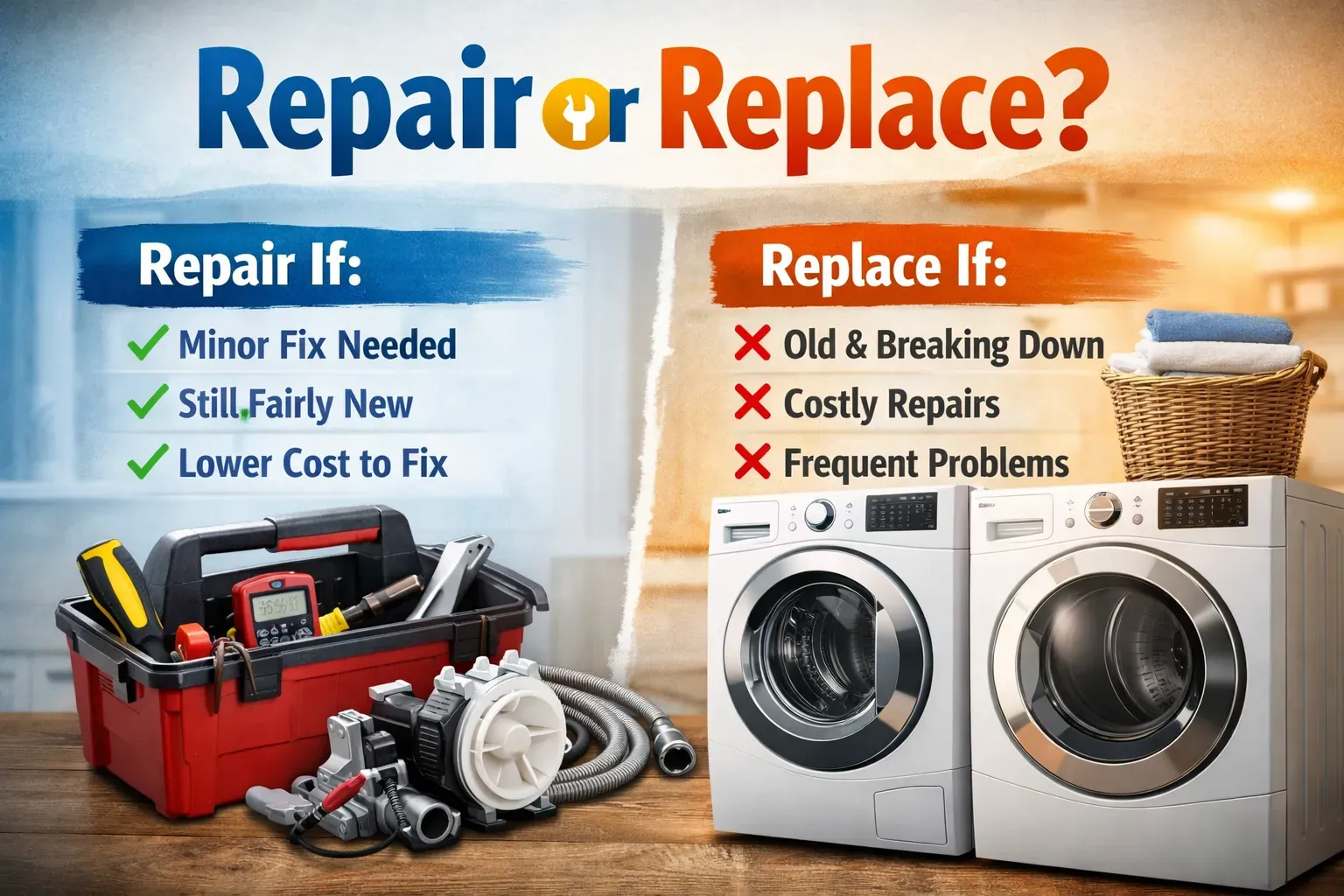
Repair usually makes sense when the appliance is still in a reasonable age range, the problem is isolated, parts are available, and the repair cost is clearly lower than replacement. Replacement usually makes more sense when the unit is older, repairs are stacking up, parts are expensive or hard to get, or the machine is no longer dependable for daily use.
A realistic rule of thumb is that many washing machines average around 10 years of service, while many dryers can last closer to 13 years under normal use. Actual life can vary widely based on load size, maintenance, build quality, dryer vent condition, and how heavily the machine is used.
What Is a Realistic Lifespan for a Washer or Dryer?
There is no perfect number because usage, maintenance, load size, climate, and build quality all matter. Still, realistic planning helps you avoid spending too much on a machine that is near the end of its useful life.
```| Appliance | Useful Planning Range | What Affects Lifespan |
|---|---|---|
| Washing machine | Often around 10 years on average, with some lasting less and some lasting longer | Load size, balance, water conditions, detergent use, drain/spin problems, and repair history |
| Dryer | Often around 13 years, especially when airflow is good and the machine is not overworked | Vent airflow, lint buildup, heating performance, drum support wear, and maintenance habits |
In Florida, heavy laundry use, high humidity, and long drying cycles can push machines harder than homeowners expect. Dryer vent airflow is especially important. A restricted vent can make a dryer seem worn out when the real problem is airflow. For more on that, see Dryer Vent Cleaning vs Dryer Maintenance.
```Signs Repair Still Makes Sense
A repair is often the better choice when:
- The machine is still fairly young for its category.
- The issue is limited to one common part or one clear failure.
- The appliance has otherwise been dependable.
- The cabinet, tub, drum, and major structure are still in good shape.
- The repair cost is much lower than buying a comparable replacement.
- Parts are available without long delays or unusually high pricing.
Examples might include a bad washer door latch, worn dryer belt, faulty drain pump, dryer rollers, a sensor problem, or a correctable vent restriction. Those situations do not automatically mean the whole machine is at the end of its life. If your washer will not drain or spin, start with Why Won’t My Washing Machine Drain? and Why Won’t My Washing Machine Spin?.
```Signs Replacement May Be the Smarter Move
Replacement often becomes more realistic when:
- The washer or dryer is already near or beyond a normal lifespan range.
- You are facing a second or third repair within a fairly short period.
- The estimate is high compared with the value of the machine.
- Key parts are discontinued, delayed, or unusually expensive.
- The appliance has rust, cabinet deterioration, tub damage, drum damage, or major wear.
- The machine no longer fits your household needs for capacity, noise, speed, or efficiency.
If a laundry appliance is breaking down often, the bigger issue is not just one invoice. It is the ongoing disruption: wet clothes sitting in the washer, long dry times, repeat service calls, and uncertainty every week.
```A Practical Way to Think About Repair Cost
A common-sense test is simple: if the repair is modest and the machine still has good years left, repair is often worthwhile. If the estimate is large and the appliance is already older, replacement may be the better long-term value.
That does not mean the cheapest answer is always best. A lower repair bill on a worn-out machine can still be a poor value if another major part is likely to fail soon. On the other hand, a solid repair on a newer machine can buy several more reliable years.
Washer Warning Signs That Push Toward Replacement
Some washer problems are very repairable. Others can become expensive quickly, especially when the machine is older or already has multiple symptoms.
```- Leaking from the tub or major internal seal area
- Repeated drain or spin failures
- Severe bearing noise or basket play
- Rust spreading around the cabinet, lid, top, or suspension areas
- Control board issues combined with other age-related wear
- Multiple prior repairs on an already older machine
- Breaker trips, burning smells, or major electrical symptoms
If the washer is stopping mid-cycle, leaving clothes wet, shaking violently, or tripping the breaker, those symptoms should be diagnosed before making the repair-vs-replace call. Helpful related guides include Why Does My Washing Machine Stop Mid-Cycle?, Why Does My Washing Machine Leave Clothes Soaking Wet?, and Why Is My Washing Machine Tripping the Breaker?.
```Dryer Warning Signs That Push Toward Replacement
Dryers often last longer than washers, but they can become poor repair candidates when several issues stack up at the same time.
```- Drum support wear plus heating or control problems at the same time
- Very long dry times even after airflow issues are addressed
- Motor problems on an older dryer
- Electrical burning smell or repeated safety shutoffs
- Cabinet deterioration, drum damage, or chronic noise from several worn components
- Heating problems plus older age and prior repair history
Before assuming the dryer is bad, remember that airflow matters. A restricted vent, crushed duct, or heavy lint buildup can make a dryer seem much worse than it actually is. If dry times are the main complaint, start with Why Is My Dryer Taking Too Long to Dry?, Why Is My Dryer Leaving Clothes Damp?, and LG Dryer D80 Error Code.
```When Energy Savings Should Factor Into the Decision
If your washer is older, replacement can sometimes make more sense sooner than expected. Newer models are often designed to use less water and energy, which can help lower operating costs over time.
That does not mean every older machine should be replaced immediately. It just means operating cost is part of the picture, especially for households doing frequent laundry every week. For dryers, energy performance is closely tied to vent airflow. A dryer with a clogged or crushed vent can waste time and energy even if the dryer itself is still in good shape.
What Beacon Usually Looks At
When our friendly technicians in yellow evaluate a washer or dryer, the decision is based on the full picture, not age alone.
```- Current failure: what is wrong right now and how severe it is
- Repair cost: whether the estimate makes sense compared with replacement
- Machine condition: cabinet, tub, drum, bearings, motor, controls, and overall wear
- Service history: whether this is the first repair or one of several recent failures
- Part availability: whether parts are available, delayed, discontinued, or unusually expensive
- Household needs: whether the appliance still fits your load size, usage, and reliability needs
- Dryer airflow: whether venting is making a dryer look worse than it really is
Sometimes the honest answer is, “This is worth fixing.” Other times the better answer is, “You may be better off putting this money toward replacement.”
```When to Call Beacon
If your washer or dryer is making unusual noises, not heating, not spinning, leaking, stopping mid-cycle, or taking too long to finish a load, it may still be very repairable. A proper diagnosis helps you avoid replacing a machine too early or spending money on a repair that no longer makes sense.
Beacon Services & Appliances helps homeowners in Beverly Hills, Inverness, Lecanto, Crystal River, Homosassa, Citrus Springs, Dunnellon, and nearby Citrus County communities with washer troubleshooting, dryer troubleshooting, dryer vent cleaning, and honest repair-vs-replace recommendations.
``` ```Prevent This Next Time
- Do not overload the washer or dryer.
- Clean the dryer lint screen every load.
- Keep the dryer vent path clean and unobstructed.
- Use the right detergent and amount for the washer.
- Address small noises or performance changes early.
- Level the machine so vibration does not create extra wear.
- Schedule service before repeated failures turn into bigger repair decisions.
Simple maintenance and earlier attention to small problems can often help a washer or dryer last longer.
```Content Update & Editorial Review
This article was reviewed on April 5, 2026 by Chris and the Beacon team for accuracy and clarity.
We update washer and dryer guidance regularly to reflect common repair, replacement, airflow, and lifespan questions we see from Citrus County homeowners.
Frequently Asked Questions
```How many years should a washer usually last?
A realistic range is often about 5 to 15 years, with many washers landing somewhere around 10 years depending on brand, usage, maintenance, and how heavily the machine is worked.
Do dryers usually last longer than washers?
Often, yes. Dryers are commonly expected to last longer than washers, with around 13 years being a useful rule of thumb in many cases.
Is it worth repairing a 10-year-old washer?
Sometimes. If the problem is limited and the repair cost is reasonable, it can still be worth it. If the machine has multiple wear issues or a high estimate, replacement may be smarter.
Should I replace my dryer if it takes too long to dry clothes?
Not always. Long dry times are often caused by vent restrictions or airflow problems first. The dryer should be checked before assuming the appliance itself needs replacement.
What is the biggest sign it is time to replace instead of repair?
The clearest sign is usually a combination of age, a high repair estimate, and repeated breakdowns. One problem alone does not always mean replacement, but several factors together often do.
Can a newer washer or dryer still be worth repairing?
Yes. If the unit is still well within a normal lifespan range, repair is often the more practical and cost-effective choice.