
Range or oven not heating right?
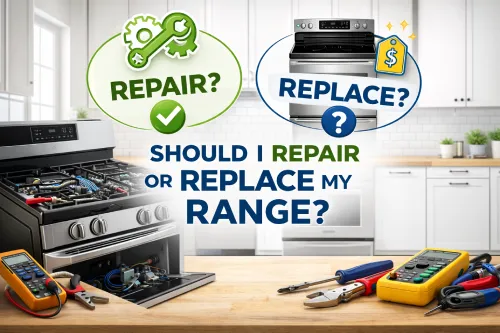
Should I repair or replace my range or oven?
The right choice depends on the age of the range or oven, what failed, repair cost, parts availability, and how well the appliance still cooks day to day. Newer electric and induction ranges with one clear part failure are often worth repairing. Older units with repeated repairs, poor temperature performance, wiring or heat damage, or a repair estimate close to replacement cost may be better candidates for replacement.
For many homeowners, the decision is not just “can it be fixed?” It is whether the repair is a good long-term value. A failed bake element or temperature sensor on a newer range is very different from an older unit with repeated control failures, uneven baking, slow preheat, or multiple symptoms at the same time.
What to Consider First
```1. Age of the appliance
If the range is under about 8 years old, repair is often the first choice. If it is 12 to 15+ years old, replacement becomes easier to justify for expensive repairs or repeat failures.
2. Type of failure
Bake elements, surface elements, sensors, latches, and some controls may be repair-friendly. Major wiring damage, repeated board failures, and multiple symptoms are harder to justify on older units.
3. Repair cost
If the repair is under about half the cost of a comparable new range and the appliance is otherwise in good shape, repair may be a good value. If the repair approaches replacement cost, compare both options.
4. Cooking performance
If the oven has been baking unevenly, preheating slowly, or failing to hold temperature, replacement may improve daily cooking results, not just prevent another repair.
Quick Decision Guide
- If it is under about 8 years old: repair is usually worth considering first.
- If it is 8 to 12 years old: compare the repair cost, parts availability, and cooking performance.
- If it is 12 to 15+ years old: replacement often makes more sense for expensive repairs or repeat issues.
- If the repair is under about 50% of a comparable new range: repair may be a good value on a healthy unit.
- If the repair approaches replacement cost: replacement usually deserves a serious look.
- If the appliance has had multiple recent repairs: replacement may reduce future frustration.
- If cooking results have been poor for a while: consider whether a new range would improve daily use.
Safety First: Heat and Electrical Issues Matter
- Beacon focuses on electric and induction ranges and ovens.
- Do not use the appliance if you smell burning, see sparks, or notice damaged wiring.
- Do not keep resetting a breaker if the range or oven repeatedly trips it.
- Do not open electrical panels or test high-voltage components unless you are trained to do so.
- Stop using the oven if the control area, outlet, cord, or wiring shows signs of overheating.
- Get a clear diagnosis before spending money on a major control, wiring, or heating repair.
Repair or Replace: Decision Guide
```| Situation | Repair May Make Sense When | Replacement May Make Sense When |
|---|---|---|
| Age | The range or oven is newer, usually under about 8 years old, and otherwise in good shape. | The appliance is 12 to 15+ years old and needs an expensive repair. |
| Heating failure | The problem is a clear bake element, broil element, burner, sensor, or repairable part issue. | The unit has repeated heating failures, wiring damage, or cannot hold temperature after repairs. |
| Control problems | The range is newer, parts are available, and the control issue is isolated. | The unit has repeated control board/keypad failures or multiple electrical symptoms. |
| Cooking performance | The oven cooked well before the failure and the current problem has a clear cause. | The oven has long-term uneven baking, slow preheat, poor temperature control, or daily frustration. |
| Repair cost | The repair is reasonable compared with a comparable new electric or induction range. | The repair approaches or exceeds about half the cost of a comparable replacement. |
| Fit and features | You like the current size, layout, features, and cooking performance. | You want better baking, quieter operation, induction performance, updated features, or a better fit. |
Start with the Age of the Range or Oven
Age is not the only factor, but it helps frame the decision. A newer range with one failed part may have years of useful life left. An older range with repeated failures may not be worth another large repair.
```- Under about 8 years old: repair is usually the first choice unless there is major damage or repeated failure.
- About 8 to 12 years old: it depends on the specific issue, repair cost, parts availability, and overall condition.
- About 12 to 15+ years old: replacement often makes more sense if repairs are stacking up or performance is inconsistent.
If you are not sure how old it is, look for a model and serial tag inside the oven door frame, behind the drawer, or along the frame of the unit. Beacon can help interpret it during service.
For more on expected lifespan, see How Long Should a Range or Oven Last?.
```Look at the Type of Problem
Some range and oven problems are good repair candidates, while others can be harder to justify, especially on older appliances. The root cause matters because “not heating right” can mean several very different things.
```Often Worth Repairing
- Bake element or broil element failure
- Burner or surface element failure, including coil or radiant elements
- Temperature sensor issues
- Door gasket, latch, or hinge problems
- Control or keypad issues on newer models when parts are available
May Push You Toward Replacement on Older Units
- Repeated control board failures
- Major wiring damage or heat damage
- Multiple issues at once, such as heating, display, and door-lock problems together
- Oven that cannot hold temperature even after common parts are replaced
- Glass-top damage or structural cabinet damage that makes the repair less practical
If your issue is more specific, these may also help: Why Is My Oven Not Heating?, Why Is My Electric Burner Not Working?, and Why Is My Oven Temperature Off?.
```Compare Repair Cost to Replacement Cost
A practical guideline is to compare the repair estimate to the cost of a comparable new range. This is especially important if the appliance is older or has had more than one repair recently.
```- If the repair is under about 50% of a comparable new range and the unit is otherwise in good shape, repair usually makes sense.
- If the repair approaches or exceeds about 50% and the range is older or has had repeated issues, replacement is usually the better value.
A Simple Repair-Value Check
- Good repair candidate: newer unit, one clear failure, consistent performance, and no broader electrical or heat damage.
- Poor repair candidate: older unit, multiple complaints, repeated repairs, poor temperature performance, or a repair estimate too close to replacement cost.
Performance Problems That Matter
Some symptoms are more than minor annoyances. They affect everyday cooking results and whether you still trust the appliance.
```- Wide temperature swings that cause food to burn, undercook, or bake unevenly
- Very slow preheat or “takes forever to bake” complaints
- Uneven heating that affects cookies, casseroles, pizzas, or roasts
- Burners cycling poorly or not responding the way they used to
- Control or display problems that make the appliance frustrating to use
If temperature consistency is your biggest complaint, see What Causes an Oven to Bake Unevenly? and What Does Convection Do on an Oven?.
```When Repair Usually Makes Sense
Repair is often the better decision when the appliance is still fairly new, the problem is limited to one common part, and you are happy with how it cooks overall.
```- The appliance is still fairly new
- The problem is limited to one common repairable part
- The repair estimate is reasonable
- The oven has otherwise been cooking well
- You are happy with the size, fit, and features of the current unit
- Parts are available and there are no signs of broader heat or electrical damage
When Replacement Usually Makes Sense
Replacement often becomes the better path when the unit is older, performance has been declining, repairs are stacking up, or the repair cost is too close to the cost of a comparable new model.
```- The unit is older and performance has been declining
- You have already paid for multiple repairs
- The repair is expensive compared with a comparable new model
- You want better cooking performance, more consistent baking, or a move to induction
- The appliance no longer fits your household’s cooking needs
- There is wiring, heat, glass-top, cabinet, or structural damage that makes repair less practical
What a New Range or Oven May Improve
Sometimes replacement is not just about avoiding another repair. A newer electric or induction range may improve everyday cooking results, especially if the current appliance has always been slow, uneven, or frustrating.
```- More even baking, especially with convection designs
- Faster, more responsive cooking, especially with induction
- Updated safety features and better control accuracy
- Useful features like air fry modes, improved timers, and better cleaning options
- Better surface layout for larger cookware or frequent cooking
- New warranty coverage
To compare features before you replace, see What Should I Look for When Buying a New Range or Oven?, What Is the Best Range or Oven Brand to Buy?, and Induction vs. Electric Range, Which Is Better?.
```Do Not Forget Electrical Requirements and Fit
Before replacing a range or oven, confirm the practical installation details. A new appliance is only a good fit if it works with the kitchen opening, outlet location, and electrical requirements.
```- Dedicated circuit and breaker size are appropriate for the new range
- Outlet location and cord reach will work once the unit is pushed back
- Cutout size and door clearance fit the kitchen layout
- Width matches what the kitchen is built around, especially for older slide-in or specialty units
- Induction compatibility is confirmed before purchase
For more prep help, see How Do I Measure for a New Range or Oven? and What Do I Need to Do Before My New Range Is Installed?.
```What Beacon Usually Checks
When our friendly technicians in yellow help with a range or oven repair-versus-replacement decision, we diagnose the actual failure first and then explain whether repair still makes practical sense.
```- Age and condition: model/serial age, surface condition, door condition, and overall wear
- Heating system: bake element, broil element, surface elements, sensors, and temperature behavior
- Control behavior: display, keypad, control response, and error symptoms
- Electrical safety clues: wiring, heat damage, breaker trips, cord/outlet concerns, and signs of overheating
- Cooking performance: preheat time, temperature swings, uneven baking, and burner response
- Repair value: how the estimate compares with a comparable new electric or induction range
- Replacement fit: size, outlet location, circuit requirements, and kitchen layout considerations
When to Call Beacon
Call Beacon if your electric or induction range is not heating correctly, baking unevenly, tripping a breaker, showing control issues, or facing a repair estimate that makes you wonder whether replacement is smarter.
Beacon Services & Appliances helps homeowners in Beverly Hills, Inverness, Lecanto, Crystal River, Homosassa, Citrus Springs, Dunnellon, and nearby Citrus County communities with electric and induction range repair, oven troubleshooting, and replacement guidance.
``` ```If You Replace It, Choose the Next One Carefully
If replacement is the better move, choose based on how you actually cook, not just the sale price. Think about oven consistency, cooktop style, surface layout, cleaning features, convection, induction, size, outlet location, and how often the appliance is used.
``` ```Content Update & Editorial Review
This page was reviewed for clarity, homeowner guidance, and practical range and oven repair-versus-replacement information on March 14, 2026 by Chris at Beacon Services & Appliances.
We update appliance guidance regularly to reflect common repair decisions we see in Citrus County homes and to keep recommendations practical, honest, and easy to understand.
Frequently Asked Questions
```What is the most common reason an electric oven stops heating?
One of the most common causes is a failed bake element or a faulty temperature sensor. These are often straightforward repairs when parts are available and the rest of the appliance is in good condition.
If my oven heats but will not hold temperature, is that usually repairable?
Often, yes. Temperature stability issues can come from a sensor problem, a control issue, or a failing element. A diagnosis helps confirm which part is actually at fault.
How do I know if a range repair is too expensive?
A common guideline is that if the repair approaches about half the price of a comparable new range, especially on an older unit, replacement usually makes more sense.
Does upgrading to induction require a special outlet?
Most induction ranges use a dedicated 240V circuit like many electric ranges, but breaker size, outlet type, outlet location, and model requirements still need to be confirmed before purchase.
Should I replace my range if it has had multiple repairs already?
Repeated repairs can be a sign the appliance is reaching the end of its practical lifespan. If your range is older and issues keep piling up, replacement may be the better long-term value.
Is a bad bake element usually worth repairing?
In many cases, yes. A failed bake element is often one of the clearer and more reasonable electric oven repairs, especially if the rest of the appliance is in good shape.
When does induction replacement make more sense than repairing an old electric range?
If your current range is older, repairs are becoming more frequent, and you want faster response with more precise temperature control, replacement with induction may be the better long-term move.
Can Beacon help me choose a replacement range if repair is not the best value?
Yes. Beacon can help diagnose the current problem, explain whether repair still makes sense, and help you compare replacement options that fit your kitchen and cooking style.