
Why Does My Oven Take So Long to Preheat?
Q: Why is my oven taking so long to preheat?
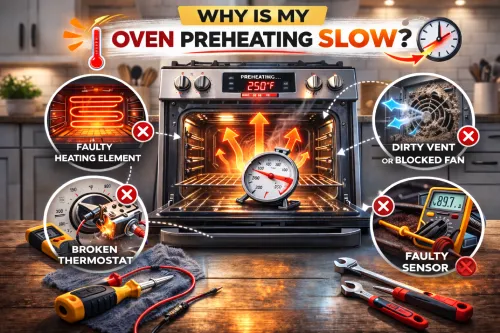
A: If your oven regularly takes 20 minutes or more to preheat, you are not imagining it, and it is not always normal. Preheat time depends on how much heat the oven can produce and how well it keeps that heat inside. On electric ovens, slow preheating is most often caused by a weak bake element, a temperature-sensor problem, heat loss around the door, airflow issues, or on some models, a failing convection fan.
This guide focuses on electric ovens and ranges and helps explain what is normal, what is not, and what you can safely check before calling Beacon.
Learn more in the Oven & Range Help Center. If your oven has a related symptom, you may also want to read Oven Not Heating, Oven Not Baking Evenly, and Why Is My Oven Temperature Off?.
1. Weak or failing bake element
The bake element provides most of the heat during preheat. Even if it glows red, it may still be underheating and taking much longer than it should to bring the oven up to temperature.
Common signs:
- The element glows unevenly
- Some sections look dimmer than others
- The oven warms slowly and struggles to reach the set temperature
- Preheat seems to stall before it finally catches up
A weak bake element is one of the most common reasons an electric oven suddenly feels “slow” without being completely dead.
2. Temperature sensor problems
The temperature sensor tells the control when to keep heating and when to stop. If it reads incorrectly, the oven may stop heating too soon or hesitate during preheat.
Common signs:
- Preheat pauses or seems to hang
- The oven reaches part of the way, then climbs very slowly
- Baking temperatures feel inconsistent from one use to the next
- The oven says it is ready, but food still cooks too slowly
If your oven also seems to run hotter or cooler than expected after preheat, this becomes even more likely.
3. Heat loss around the oven door
A good door gasket helps keep heat inside the oven cavity. If the gasket is worn, flattened, torn, or not sealing evenly, the oven can lose heat faster than it should during preheat.
Signs the gasket may be part of the problem:
- You see visible tears, gaps, or flattened areas
- You feel hot air leaking around the door edges
- The oven seems to run constantly to hold temperature
- The kitchen gets hotter than usual while the oven is warming up
Heat loss does not always cause a total failure. Sometimes it simply makes the oven slower and less steady.
4. Failing convection fan, on convection models
On convection ovens, the fan helps move heat around the cavity. Some models also use convection during preheat to speed things up. If the fan is weak, noisy, or not running, preheat may take noticeably longer.
Common signs:
- The fan does not spin, or only spins intermittently
- The fan is noisy, grinding, or rattling
- Convection does not seem to improve preheat time or baking performance
If convection used to feel faster and now does not, the fan or its control may need attention.
5. Airflow blockage inside the oven
Storing oversized cookware, sheet pans, or pizza stones inside the oven can slow preheat, especially if the items block airflow paths or sit close to the bake element area.
Quick check: Remove stored pans, stones, and heavy cookware, then try preheating again to see if the timing improves.
This will not cause every slow-preheat complaint, but it is an easy thing to rule out before assuming a part has failed.
6. A hidden control or relay problem can also slow preheat
On some ovens, the control board or a relay issue can limit how the heating system behaves during warm-up. That can look like a weak element or sensor problem from the outside.
Possible clues:
- Preheat times vary wildly from one use to another
- The oven occasionally preheats normally, then becomes slow again
- You hear repeated clicking from the control area
- The display behaves oddly during warm-up
This is usually not something a homeowner can confirm without testing.
What is a normal preheat time?
Preheat time varies by oven size, wattage, insulation, and target temperature. As a practical rule, many electric ovens reach 350°F in about 10 to 15 minutes under normal conditions. If yours consistently runs much longer than that, especially with changing cooking results, it is worth investigating.
Preheat also takes longer when:
- You are aiming for a higher temperature
- You leave cookware inside during warm-up
- The oven is larger or has heavier interior components
What you can safely check before calling
- Remove stored pans, stones, or oversized cookware
- Look at the bake element for obvious damage or uneven glow
- Check the door gasket for gaps, tears, or flattened spots
- Listen for unusual fan noise if the oven has convection
- Pay attention to whether the oven eventually reaches temperature or never seems to get there
If the oven is slow to preheat and also bakes unevenly or misses the target temperature, that is a stronger sign that repair is needed.
When to call Beacon
Contact Beacon Services & Appliances if you notice:
- Preheat times consistently longer than about 15 minutes to 350°F
- The oven never reaches the set temperature
- A burning smell near the element area
- Visible damage to the sensor, wiring, or door gasket
- Convection fan noise or no fan operation on a convection model
Our friendly technicians in yellow can test heating elements, temperature sensors, fans, wiring, and controls to bring your oven back to normal performance.
Related oven help:
- Oven Not Heating
- Oven Not Baking Evenly
- Why Is My Oven Temperature Off?
- Should I Repair or Replace My Range or Oven?
- Oven & Range Help Center
Content Update & Editorial Review
This article was reviewed and updated on March 15, 2026 by Chris to improve troubleshooting clarity, expand common electric-oven causes, and update structured content.
Frequently Asked Questions About Slow Oven Preheating
Is it normal for an oven to take 20 minutes to preheat?
It can happen, but consistent 20-minute or longer preheats to common temperatures like 350°F often point to a weak bake element, heat loss at the door, airflow restriction, or a sensor issue.
My bake element glows red. Can it still be bad?
Yes. A bake element can glow and still produce less heat than it should. Uneven glow, slower warm-up, and trouble reaching the target temperature are common clues.
Does leaving pans in the oven really slow preheating?
Yes. Large pans, stones, and heavy cookware can absorb heat during warm-up and sometimes block airflow, which can increase preheat time.
Will a bad door gasket affect preheat time?
Yes. If heat leaks around the door, the oven has to work harder and longer to reach and hold temperature.
Should I use convection to preheat faster?
On some ovens, convection can speed preheat and improve heat distribution. If convection does not seem to help, the fan or control may need inspection.
Can a temperature sensor make the oven preheat slowly?
Yes. If the sensor reads incorrectly, the oven may stop heating too early or heat unevenly during preheat, making the whole process take longer.