
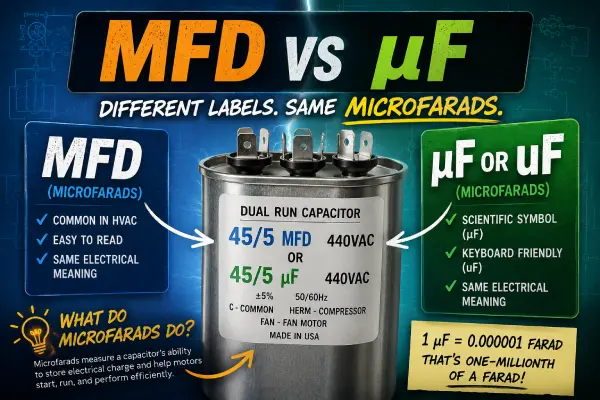
Seeing MFD, µF, or uF on a capacitor can make it seem like there are several different measurements. In most HVAC and appliance applications, they all point to the same capacitance rating: microfarads.
Quick Answer
MFD, µF, and uF normally mean the same thing on a motor capacitor: microfarads. A 35 MFD capacitor and a 35 µF capacitor have the same capacitance rating. The letters may look different because manufacturers use different label conventions, especially when the µ symbol is difficult to print or type.
Is MFD the Same as µF?
Yes. In HVAC, appliance, pool-pump, and motor applications, MFD is commonly used as another way of writing microfarads. The technically preferred symbol is µF, but many capacitor labels use MFD because it is easy to read on a small label.
For example, these ratings describe the same capacitance value:
- 5 MFD
- 5 µF
- 5 uF
All three mean a capacitor rated at 5 microfarads.
Why Are There Different Labels?
The difference is mostly about printing, keyboard limitations, and industry habits, not a difference in electrical performance.
The proper scientific symbol for “micro” is the Greek letter µ. That is why microfarads are formally written as µF. However, the µ symbol is not always easy to type, display, or print clearly on a small capacitor label. Because of that, manufacturers may use:
- µF — the formal microfarad symbol
- uF — a keyboard-friendly substitute for µF
- MFD — a common HVAC and motor-industry label for microfarads
When you are reading an air conditioner capacitor, the important number is the number before the label. A capacitor marked 45/5 MFD has the same capacitance values as one marked 45/5 µF.
What Do Microfarads Measure?
Microfarads measure capacitance. Capacitance is a capacitor’s ability to store electrical charge.
A farad is the base unit of capacitance, but one farad is a very large amount for most motor and HVAC applications. That is why capacitors are usually rated in much smaller units called microfarads.
One microfarad equals one-millionth of a farad:
1 µF = 0.000001 farad
In general, a higher microfarad rating means the capacitor can store more electrical charge at a given voltage. That does not mean a higher-rated capacitor is automatically better for every motor. Motors are designed to work with a specific capacitance range.
What Does a Capacitor Do in an Air Conditioner?
Many air-conditioning systems use capacitors to help electric motors start and run correctly. Depending on the system, a capacitor may support the compressor, outdoor fan motor, indoor blower motor, or another motor-driven component.
On many standard HVAC systems, a run capacitor helps create the phase shift a permanent split capacitor motor needs to produce useful running torque. In simple terms, it helps the motor start more smoothly, run efficiently, and maintain the correct electrical relationship between its windings.
A weak or failed capacitor can contribute to issues such as:
- An outdoor unit that hums but does not start
- A condenser fan that will not begin spinning
- A compressor that struggles to start
- Higher motor amperage or overheating
- Intermittent cooling problems
- A system that trips a breaker or safety control during startup
Capacitor failure is only one possible cause of these symptoms. A trained technician should test the capacitor along with the motor, wiring, contactor, voltage, and refrigeration system before replacing parts.
What Does 45/5 MFD Mean?
A rating such as 45/5 MFD is usually found on a dual run capacitor. A dual run capacitor combines two capacitor sections inside one metal can.
- 45 MFD is typically the compressor section.
- 5 MFD is typically the outdoor fan motor section.
These capacitors commonly have three terminal groups labeled:
- C — Common
- HERM — Compressor circuit
- FAN — Condenser fan motor circuit
The capacitor label and wiring diagram should always be checked before reconnecting wires. The terminal names matter more than wire color alone.
What Is the Difference Between MFD and mF?
This is where capitalization matters.
In HVAC capacitor labeling, MFD is commonly used to mean microfarads. But mF, written with a lowercase m, technically means millifarads.
- 1 µF = one-millionth of a farad
- 1 mF = one-thousandth of a farad
- 1 mF = 1,000 µF
That is a major difference. In everyday HVAC work, a capacitor marked 5 MFD is understood as 5 microfarads, not 5 millifarads. Still, it is smart to pay attention to the entire label rather than relying only on one letter.
Why Might One Capacitor Have a Different Rating?
Two capacitors can look similar while having very different electrical ratings. Before a capacitor is replaced, several parts of the label need to be compared:
- Microfarad rating: The rated MFD, µF, or uF value.
- Voltage rating: Common ratings include 370 VAC and 440 VAC.
- Tolerance: The allowed variation from the rated capacitance.
- Type: Start capacitor, run capacitor, or dual run capacitor.
- Physical fit: Shape, diameter, height, mounting method, and terminal layout.
For a run capacitor, the microfarad rating should match the original equipment requirement. The replacement capacitor’s voltage rating should meet or exceed the original voltage rating. For example, a properly sized 440 VAC replacement capacitor can often replace a 370 VAC capacitor with the same microfarad rating, provided it is the correct type and physically fits the application.
A 35 µF capacitor is not interchangeable with a 40 µF capacitor just because both can fit in the same bracket. The wrong capacitance can cause poor motor performance, overheating, nuisance failures, or shortened motor life.
Why Do Start Capacitors Use a Range?
Run capacitors often have one specific microfarad rating, such as 5 µF or 45 µF. Start capacitors commonly show a range, such as 189–227 MFD.
That range is part of the capacitor’s intended rating. A start capacitor temporarily provides extra starting torque, then drops out of the circuit after the motor reaches speed. Because its job is different from a run capacitor’s job, it is not selected or tested the same way.
Do not substitute a run capacitor for a start capacitor, or a start capacitor for a run capacitor, unless the equipment manufacturer’s design specifically calls for it.
Can a Larger Microfarad Capacitor Be Used?
Not as a general rule. More microfarads do not mean more cooling, more horsepower, or a better repair.
The capacitor value is selected to work with a specific motor winding design. Installing a capacitor with too high or too low of a microfarad rating can change the motor’s operating characteristics and may increase current draw, reduce efficiency, create overheating, or damage the motor over time.
The correct approach is to use the capacitor rating specified by the equipment manufacturer or the motor data plate. For a dual run capacitor, both values must be correct.
Can You Test a Capacitor Yourself?
Capacitors can retain an electrical charge even after power has been turned off. HVAC equipment also contains high-voltage components, moving parts, and wiring that can be damaged or connected incorrectly during a repair.
Capacitor Safety Reminder
Do not touch capacitor terminals or attempt to replace a capacitor unless you are trained to work safely around electrical equipment. A capacitor should be tested with the correct meter and isolated properly from the circuit before its capacitance is measured.
If your air conditioner is humming, the outdoor fan is not spinning, or the system is struggling to start, a professional air-conditioning repair visit can identify whether the capacitor is actually the problem and help prevent unnecessary parts replacement.
Capacitor MFD and µF FAQs
Is MFD the same as µF on a capacitor?
Yes. In HVAC and motor applications, MFD and µF are commonly used to describe the same microfarad capacitance rating.
Is uF the same as µF?
Yes. uF is commonly typed when the µ symbol is not available on a keyboard or label. Both mean microfarads.
What does 45/5 MFD mean on an A/C capacitor?
It usually identifies a dual run capacitor with a 45 microfarad section for the compressor and a 5 microfarad section for the outdoor fan motor.
Can I replace a 370 VAC capacitor with a 440 VAC capacitor?
A 440 VAC capacitor can generally replace a 370 VAC capacitor when the microfarad rating, capacitor type, terminal arrangement, and physical fit are correct. A lower-voltage capacitor should not replace a higher-voltage capacitor.
Can I use a different microfarad rating?
Not unless the equipment manufacturer specifically allows it. The microfarad rating should match the motor or equipment requirement.
Why does my capacitor have two numbers?
Two numbers typically indicate a dual run capacitor. Each number represents a separate capacitance section for a different motor circuit.
Does a larger capacitor make an A/C system cool better?
No. The correct capacitor is the one that matches the motor’s required rating. A larger rating can create operating problems and may shorten motor life.